Friday, June 24, 2022

At Walmart and Blue Apron Meals Matter


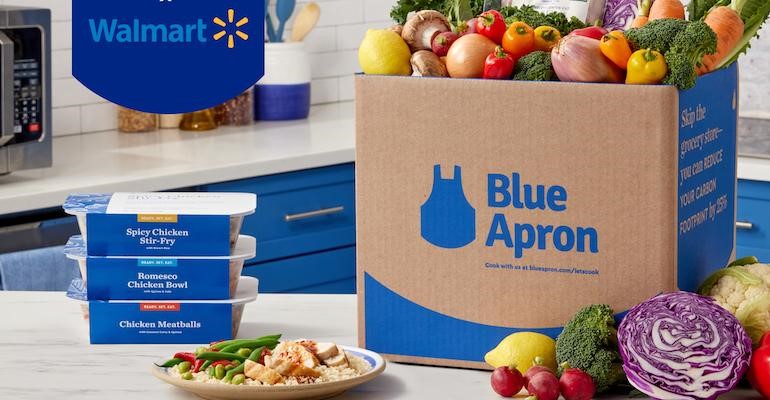
Looking to refocus its grocery department with one eye on today’s consumer and the other eye on tomorrow’s consumers Walmart is seeking incremental customer relevance with a new partnership with Blue Apron focusing on grocerant niche meals and meal components according to Steven Johnson, Grocerant Guru® at Tacoma, WA based Foodservice Solutions®. 

In a big move for both companies Blue Apron aims to broaden its audience by offering Walmart.com shoppers a selection of meals without a subscription. That’s right Blue Apron has dropped its subscription requirement for Walmart.com customers.  Great more great start according to Johnson.

Blue Apron has begun offering four meals without a subscription to online customers at Walmart.com. The strategy behind the initiative is twofold, the meal kit company explained: Suspending the subscription removes potential barriers for trial, and the plan introduces Blue Apron to a substantially wider audience.

Building a Larger Share of Stomach

Meals, Meal Components, and Beverages Matter


Dani Simpson, Blue Apron’s chief marketing officer, stated, “Through our work with Walmart.com Marketplace, we will be able to scale our e-commerce presence and introduce restaurant-quality meals without a subscription to a new group of customers who may not have considered meal kits before… “This is just the beginning, and we look forward to expanding the offering throughout the year.”

Blue Apron launched the plan with three meal kits that serve from 8 to 12 — featuring cheeseburgers with roasted potatoes, chicken rice bowls, and rosemary chicken with roasted potatoes — and a Heat & Eat selection containing six single-serve meals that are ready in 5 minutes or less, featuring beef Bolognese, beef meatballs and chicken stir-fry.

Currently, Blue Apron is the only meal-kit provider on the Walmart Marketplace platform. The boxes will be directly fulfilled by Blue Apron, maintaining the scale of its direct-to-consumer model and supply chain.

The meal-kit pioneer is promoted the concept during Walmart+ Weekend, an online savings event exclusive to Walmart+ members.

Sheetal Patel, GM of food consumables, health and wellness, Walmart U.S. Marketplace, stated, “We are thrilled to work with Blue Apron to offer an assortment of meal kits to Walmart customers,” … “At Walmart, finding ways to help our customers live a little better each day is at the heart of everything we do.”

For international corporate presentations, regional chain presentations, educational forums, or keynotes contact: Steven Johnson Grocerant Guru® at Tacoma, WA based Foodservice Solutions®.  His extensive experience as a multi-unit restaurant operator, consultant, brand / product positioning expert, and public speaking will leave success clues for all. For more information visit GrocerantGuru.com, FoodserviceSolutions.US or call 1-253-759-7869


Thursday, June 23, 2022

Circle K Is the Global Leader with ‘Smart Checkout’


Once again a global leader steps up, stands out, this time leveraging technology too edify its relevance with its target consumers while edifying its operational standards according to Steven Johnson, Grocerant Guru® at Tacoma, WA based Foodservice Solutions®.

This time we are talking Alimentation Couche-Tard Inc., one of the world’s largest convenience retailers, that recently announced it will deploy more than 10,000 Mashgin Touchless Checkout Systems branded as “Smart Checkout,” to over 7,000 of its Circle K and Couche-Tard stores during the next three years. The AI-powered self-checkout system developed by Mashgin will improve customer checkout times as much as 400%, driving customer experience forward while allowing store staff to focus their time on helping customers. View a short video of the Circle K Smart Checkout experience here.

The agreement with Mashgin launches the global deployment of the pioneering system, and represents one of the largest scale expansions of computer vision-powered checkout technology to date. It builds upon the successful deployment of Mashgin across nearly 500 Circle K locations in the U.S. and Sweden since 2020, as well as at Couche-Tard’s retail innovation lab store on the campus of McGill University in Montreal.

Referred to as “Smart Checkout” in Circle K and Couche-Tard stores, the Mashgin Touchless Checkout System is a compact countertop device that fits easily into the existing store layout. It uses computer vision to recognize items presented from virtually any angle and instantly ring them up in a single transaction. Customers place their items on the Mashgin Touchless Checkout System, which uses cameras to ring up everything in under a second. There is no need to download an app or find and scan barcodes; shoppers simply put items down, pay as they normally would, and are on their way in as little as 10 seconds – eight times faster than traditional self-checkout.


“We’re committed to investing in and scaling technology that sets a new standard for convenience with our customers and advances our mission to make our customers’ lives a little easier every day,” says Magnus Tägtström, Vice President, Global Innovation at Couche-Tard. “The Smart Checkout system powered by Mashgin’s game-changing technology shortens lines, improves the customer experience and frees up our teams to focus on helping our customers. We look forward to introducing this new platform to stores across our network.” 

Mashgin Chief Technology Officer and co-founder, Mukul Dhankar stated, “Mashgin’s core technology represents a major breakthrough in the world of artificial intelligence. By reinforcing computer vision models with three-dimensional data, we are able to reach 99.9% accuracy when ringing items. This innovation also allows the system to easily differentiate between different sizes of items with a similar appearance, and also makes it flexible enough to recognize grab-and-go foods like pizza or roller grill items that may look slightly different each time. Another key component to our technology is its ability to learn new objects in less than a minute and sync that data across stores, making it possible to set up a new store in under an hour.” 

Surveys of first-time Mashgin users at deployed Circle K locations show that 80% of those customers prefer Mashgin to traditional forms of checkout and self-checkout. Recent updates to the system to allow cash use, fuel purchase and key loyalty programs like Sip & Save have driven customer adoption. At some Circle K stores, Smart Checkout has already become customers’ favorite way to transact. 

“We’ve been hearing great feedback from our customers in the stores where Smart Checkout has been introduced, and it’s easy to see why. Mashgin’s platform is incredibly simple to use and highly intuitive for customers,” says Alex Miller, Executive Vice President Operations, North America, and Global Commercial Optimization for Couche-Tard. “Through this agreement, I am convinced that we will scale a great tool that makes it easy for our customers and team members, saving time and putting our customers and people first in our global operations.” 

Mashgin has processed over 40 million transactions to date and can be found in over 1000 locations, including Circle K and other convenience store chains, airports, Fortune 500 companies, and over 30 iconic U.S. sports stadiums and entertainment venues.


“Our vision has always been to make people’s lives better and give them back more time in their day,” says Abhinai Srivastava, CEO and co-founder of Mashgin, “We’ve already saved people over 30 years of standing in line. We’re honored to work with the fantastic team at Couche-Tard to bring that savings around the world.”

Mashgin and Couche-Tard are both actively recruiting multiple roles to help innovate retail experiences.

Success does leave clues. One clue that time and time again continues to resurface is “the consumer is dynamic not static”.  Regular readers of this blog know that is the common refrain of Steven Johnson, Grocerant Guru® at Tacoma, WA based Foodservice Solutions®.  Our Grocerant Guru® can help your company edify your brand with relevance.  Call 253-759-7869 for more information. 


Wednesday, June 22, 2022

Dinner Customized, Personalized, Delivered


Consumers are dynamic not static and restaurant delivery companies, restaurant technology companies, need to be as dynamic as the consumer or they will lose business to someone else.  Steven Johnson, Grocerant Guru® at Tacoma, WA based Foodservice Solutions®, stated, “Marc Lore’s Wonder establishes a new standard within the retail foodservice sector for meals, meal delivery, elevating customer pain points too quality touchpoints.”

Grocery technology wizard Marc Lore founder of Wonder, a mobile restaurant startup recently raised $350 million to fuel its growth. That’s real money, disruptive money and as you read on you will understand why.

Wonder was founded last year with the goal to customers a better food delivery option by partnering with well-known chefs and owning the meal process from start to finish. Key to its business model are delivery vans that double as kitchens, allowing food to be heated, assembled, and finished steps from the customer's home.


In less than a year, Wonder has expanded to 22 towns in New Jersey and is available in more than 130,000 households, according to Lore.  Let’s talk about empowering choice.  Wonder has created 19 restaurant concepts with chefs including Daisuke Nakazawa, Nancy Silverton and Bobby Flay. It has also brought 1,250 jobs to New Jersey.

Big goals require big bucks and the Series B funding round led by Bain Capital Ventures will allow Wonder to continue growing. Lore has plans to enter more markets in the tri-state area and launch 11 more restaurants for a total of 30 by this time next year.

Lore stated, "Wonder has a real opportunity to not only completely change how people eat, but also to create a better future with access to the world’s best food in a convenient, affordable, and sustainable way".

So, how does the concept work?  Let’s see, consumers can use the Wonder app to order food on-demand from its various brands, which range from high-end options like Bobby Flay Steak to more casual fare like taco-bar concept Taqueria del Dia. The meals are started in a commissary and transferred to a Wonder-branded delivery van, where a chef fires, finishes and plates it outside the customer's door. Wonder also offers delivery and pickup services to local restaurants through a platform called Envoy.

Elevating delivery Wonder's model takes aim at some of the problems with food delivery, including food quality, which tends to decline in transit. "When our mobile restaurant comes to you, your fries are crispy, your pizza is melty, and your steak is juicy," according to the Wonder PR team.


It also claims to provide better food and service, with its exclusive, chef-driven menus and uniformed employees handling the deliveries rather than a third party.

So, after Lore left his role as CEO of Walmart's U.S. e-commerce business in 2021, the serial entrepreneur co-founded a number of tech startups, including "conversational commerce" venture Wizard and sports betting app Mojo. But Wonder was the one that truly captured his imagination, he wrote in a LinkedIn post in December. In that post, he declared that he was going "all-in" on the company as founder, chairman and CEO.

Lore continued, "It has a real opportunity not only to completely change how people eat, but also to create a better future by giving them access to the world’s best food—with nutritious options—in a convenient, affordable, and sustainable way,". Success does leave clues and I suggest that this company is one to watch for clues.

Foodservice Solutions® specializes in outsourced business development. We can help you identify, quantify and qualify additional food retail segment opportunities or a new menu product segment and brand and menu integration strategy.  Foodservice Solutions® of Tacoma WA is the global leader in the Grocerant niche visit us on our social media sites by clicking one of the following links: Facebook,  LinkedIn, or Twitter


Tuesday, June 21, 2022

Little Caesars Partnership Success Clue


Success does leave clues and you don’t get to be the third largest pizza chain in the world without picking up some good clues.  One of the best clues for a food retailer to learn is that the right partnership can drive top-line sales and bottom-line profits while creating new electricity for your brand; according to Steven Johnson, Grocerant Guru® at Tacoma, WA based Foodservice Solutions®.

Everyone that reads this blog knows that Little Caesars, is the home of the famous HOT-N-READY pizza, and the NFL today announced a multi-year partnership that names Little Caesars as the Official Pizza Sponsor of the National Football League. As one of Little Caesars highest-profile partnerships to date, the collaboration will continue to build on Little Caesars momentum of growth over the past several years.

Now when you are thinking brand relevance in an evolving world, what will edify brand value with relevance and new electricity? At Little Caesars it is the NFL. According to Johnson, “Brand relevance is in part driven with innovation in new food products in combination with new avenues of distribution all of which are the platform for the new electricity.” 

Johnson stated “that in my minds-eye the new electricity must be very efficient for the supply and includes such things as fresh foods, smaller footprint, developing brands, fresh flowers, grocerant positioning, fresh food messaging, autonomous delivery, cashier-less retail, plates, glasses, cash-less payments, digital hand-held marketing.

All retailers to survive the next generation of retail must embrace the artificial intelligence revolution while simultaneously embracing fresh food that is portable according to Johnson.

Growing a Larger Share of Stomach

with Partnerships Works


There is no doubt that eating pizza and cheering on the home team combine to make the perfect weekend social activity.  Little Caesars plans to be a special part of those game-time meal occasions.  The brand, which revolutionized the pizza industry with HOT-N-READY pizzas for convenient pickup and launched the pizza industry’s lowest priced delivery at the 2020 Super Bowl. 

This partnership makes a perfect match for the over 100 million NFL fans who regularly watch football games and want their gametime meals quickly and easily -- whether they choose delivery, exclusive Pizza Portal pickup, or carry-out. Little Caesars is known for unique product offerings and promotions like the Pretzel Pizza, Detroit-Style Deep Dish Pizza, the Batman Calzony, and now offers 33% more pepperoni on its Classic pizza.

Renie Anderson, Chief Revenue Officer and Executive Vice President of NFL Partnerships, stated, “We’re thrilled to welcome Little Caesars to the NFL family,” says. “With a focus on quality and convenience, Little Caesars offers unmatched value for our fans, and we look forward to working together to positively impact communities across the United States.”

Expanding visibility to its target demographic the deal comes about a month before the start of team training camps, the annual unofficial kickoff of the NFL season. The agreement will offer Little Caesars a set of exclusive marketing rights designed to connect the pizza brand with the NFL.  There will be some exciting new components like social media games, new products, new packaging, and unique promotions will be revealed before the start of the 2022 season and continue throughout the course of the sponsorship.

Dave Scrivano, president and CEO of Little Caesars, stated, “This partnership aims to enhance the fun of game day by bringing the quality and convenience Little Caesars is known for to NFL fans across the country,”… “And because we’re the value leader in the pizza industry, hungry fans can enjoy weekly gametime meals at a very affordable price during a time when food prices are on the rise.”

Looking for success clues of your own? Foodservice Solutions® specializes in outsourced food marketing and business development ideations. We can help you identify, quantify and qualify additional food retail segment opportunities, technology, or a new menu product segment.  Foodservice Solutions® of Tacoma WA is the global leader in the Grocerant niche visit us on our social media sites by clicking one of the following links: Facebook,  LinkedIn, or Twitter 


Monday, June 20, 2022

Restaurant Sales Outlook Dims


At the intersection of Consumer Sentiment Index and continued declines in year over year restaurant visits the prospects for growth are dimming according to Steven Johnson, Grocerant Guru® at Tacoma, WA based Foodservice Solutions®. “The continued customer migration from legacy chain restaurants to too new non-traditional points of fresh food distribution are elevating consumer choice leaving those unwilling to adapt at a disadvantage” according to Johnson.

There is no doubt that grocerant niche Ready-2-Eat and Heat-N-Eat fresh prepared food continues to garner market share as consumers seek meals and meal components that are quick to obtain, fresh, and fast to prepared.  Empowering personalized, customized, family meals.

So, the University of Michigan’s latest Consumer Sentiment Index recorded consumer sentiment in May at 58.4, a 10.4% drop from April’s 65.2 figure, putting it at virtually the same level of sentiment seen in March.

“This recent drop was largely driven by continued negative views on current buying conditions for houses and durables, as well as consumers’ future outlook for the economy, primarily due to concerns over inflation,” Surveys of Consumers Director Joanne Hsu said.


Once again consumers’ assessment of the labor market,  was less positive, the Conference Board noted. More than half (51.8%) of consumers said jobs were “plentiful,” down from 54.8% in April, and 12.5% of consumers said jobs are “hard to get,” up from 10.1%.

So, The NPD Group reported that there was a 4% decline in consumer visits to U.S. restaurants this April compared to a year ago. Factors that contributed to this decline include food inflation, rising costs and a 9% increase in the price of a foodservice meal compared to April 2019.

When you consider that restaurant traffic in April was 11% below the pre-pandemic level in April 2019. The 1% increase in consumer spending at restaurants in April versus a year ago was more a reflection of higher prices than increased use of restaurants, according to NPD’s daily tracking of the U.S. foodservice industry.

Note that, online and physical visits to quick-service restaurants (QSRs) declined by 4% in April compared to a year ago and is 6% below the April 2019 pre-pandemic baseline. Traffic to full-service restaurants (FSRs), which had the steepest declines during the pandemic, was down 3% this April compared to a year ago, which is 31% below April 2019 visits.

Here is the problem for consumers; rising restaurant prices have had the most impact on lower-income households and households with kids. For consumers in households with annual incomes under $50,000, their restaurant visits declined by 11% in April 2022 compared to the same month a year ago. Traffic from households with kids under age six was down 8% and decreased by 9% for households with kids ages six to 12 in April compared to a year ago. Visits from groups with kids, from the same home or not, were down 14% from a year ago, while traffic from adult-only groups was up 1% this April compared to April 2021.


What is needed is some marketing magic according to Johnson, who stated, “restaurants need now more than ever to evolve their brand invitation from pay more for an old product, to new menu options for less, with a smile.”

The fact is business models from 1999, 2009, 2019 won’t work in 2022 or 2023.  Without evolving with customer relevance year over year customer counts will continue to decline.

Don’t over reach. Are you ready for some fresh ideations? Do your food marketing ideations look more like yesterday than tomorrow? Interested in learning how Foodservice Solutions® can edify your retail food brand while creating a platform for consumer convenient meal participation, differentiation and individualization?  Email us at: Steve@FoodserviceSolutions.us or visit us on our social media sites by clicking the following links: Facebook,  LinkedIn, or Twitter


Sunday, June 19, 2022

Is Artificial Intelligence Better than Operator Intelligence


Restaurants, Convenience Stores, and Bodegas have long relied on the imagination and innovation of their founds, owners, or savvy marketing professional.  Those days are not all gone but there are fewer and fewer food retailers that can honestly say they have their pulse of the consumer.

According to Steven Johnson, Grocerant Guru® at Tacoma, WA based Foodservice Solutions® “crunching the numbers today more often than not means analyzing data, big data about customers, menu items, and sales trends simultaneously. That requires software using what is known now as artificial intelligence.  That intelligence is not artificial at all.  Today, it is insightful, informative, and filled with fact-based relevance.”

Yes, artificial intelligence (AI) may sound futuristic, but AI is here today and the technology can help convenience store retailers with their marketing campaigns. Ryan DiLello, content specialist for Paytronix Systems Inc., stated, "Using AI saves you time, effort and money," … "It ensures you do not have one-size-fits-all campaigns. It allows you to learn more about your customers and meet their needs."


DiLello continued, “Specifically, AI can help c-store retailers learn more about their customers' behavior and value; segment customers in more exacting ways; make more compelling, personalized offers; maximize channel efficiency; and, find ideal customers in the marketplace using AI-constructed profiles. AI-driven marketing operates through four stages, They are:

1.       Segmentation

2.       Predictive Analytics

3.       Campaigning

4.       Analysis

Then speaking about C-stores DiLello went on to say; “One thing AI can do is provide data regarding how likely customers are to visit a c-store, as well as open emails with provided targeted offers. The data can, for example, show which days a customer is visiting a store. If a customer visits exclusively on weekdays, AI can generate targeted offers to try to encourage consumers to visit on the weekend.”

Consider this, AI can also help launch "Missed Visit Campaigns," which recognizes individual lapses in guest behavior and identifies guests "out of their rhythm." Now according to DiLello, results from the first seven days of a Missed Visit Campaign revealed guest visits increased by 42 percent and in-store spending rose by 19 percent.

This is an example of how proactive AI can be. Geofencing, when AI notices when a customer is near a store and provides targeted offers and promotions, is another way to draw in-store traffic. "We have seen great results using geofencing," DiLello said.


Many C-store retailers have also used K-Means Clustering. Through this method, AI looks at popular pairing items and makes recommendations based on trends in the data. Further, K-Means Clustering helps develop unique and personalized guest experiences intended to keep customers returning to the store.

"AI recommends coupon offers," DiLello said. "It is a low-risk way to win back customers."

More than just marketing, AI can help c-store retailers beyond just marketing, making their implementation well worth the investment, DiLello stressed. The technology takes it one step further by helping to determine a key metric: customer lifetime value (CLV). AI calculates how long a person has been in a loyalty program, what the average visit cadence looks like, when the most recent visit was, how much customers spend per visit and how long the consumer is likely to stay active. These data sets are important to identify top customers, segment more effectively, optimize acquisition and realize lift — or a customer's lifetime journey.

So, the objectives of CLVs are to identify and reward most valuable customers, and find lower-value customers and boost their CLV.  "People often ask what a good CLV to customer acquisition cost (CAC) ratio is. We often say a three-to-one ratio is good," DiLello explained.

Retailers can lower CAC by retaining customers longer, reducing media and advertising expenses, and reducing third-party marketplace fees, he added.

Looking a Customer Ahead, DiLello expects AI to provide c-store retailers with practical uses in operations. For example, robotic servers, kiosks with facial recognition, food waste reduction management, inventory management and smart routing for delivery are ways AI can benefit c-store operators down the road.

"Inventory management is big for c-stores," he said. "AI will allow retailers to cruise through an unsteady supply chain to order items months in advance." Once again the team at Foodservice Solutions® would like to recommend you visit Paytronix Systems Inc more information on AI Or simply contact us for a referral.

Looking for success clues of your own? Foodservice Solutions® specializes in outsourced food marketing and business development ideations. We can help you identify, quantify and qualify additional food retail segment opportunities, technology, or a new menu product segment.  Foodservice Solutions® of Tacoma WA is the global leader in the Grocerant niche visit us on our social media sites by clicking one of the following links: Facebook,  LinkedIn, or Twitter