Tuesday, November 3, 2015

Millennials Helping Turn McDonalds and C-store Sales Around


Millennials, the 83.1 million Americans born between 1982 and 2000 who now represent the largest single age group in the U.S. “Prior to the Great Recession, they were the heaviest users of restaurants,” said Bonnie Riggs, a restaurant industry analyst with research firm NPD Group. “They got hit hardest by the recession with high unemployment (and) student debt. From 2008 to 2015, millennials have cut back per person (by) 50 visits.”

Considering the size of the group, she said, “that’s a lot of lost volume.” Riggs continued. So, who lost the most? The list includes OSR’s the ilk of Wendy’s, Burger King, and McDonalds plus Chili’s Grill & Bar, Red Lobster, and TGI Fridays to name but a few. 

Millennials are now making their way back to restaurants but not just to QSR’s or traditional outlets. Rich Hicks, chief executive of the Mooyah Burgers, Fries & Shakes chain stated “millennials are a big part of where we are today, and they’re a growing piece,…Millennials make up about 35 percent of his customer base, up from 25 percent a few years ago.

Grocerant niche Ready-2-Eat and Heat-N-Eat fresh prepared food is garnering new customers from every segment including millennials.  “Quick service restaurant customers often choose foodservice, from grocery stores, and convenience stores”, according to a new analysis by the NPD Group.

Between, March to June 2015, the number of fast food purchases per customer made at supermarkets and c-stores was over six visits higher than those made at QSRs in an average four-week period. That is customer migration that Foodservice Solutions® Grocerant Guru® has been pointing out since 1991, but’s it has ramped up big time now. 

Food industry research icon Bonnie Riggs, an NPD restaurant industry analyst, said in a press release “Consumers use QSRs, convenience and grocery stores interchangeably for fast food, particularly when they find the same quality and variety “The lines between retail foodservice and QSRs are blurring for consumers, and these channels are competing for visits from consumers looking for a quick meal or snack.”

McDonald’s breakfast anytime is the perfect empowerment message for millennials.  Success does leave clues.  McDonald’s picks the clues up very well.  While some franchise operators complained about implementation difficulties the results speak for themselves.  Sales are up.  Customers win. Don’t let your customers migrate adapt, evolve, and remember the customer id dynamic and you must be as well.

Are you trapped doing what you have always done and doing it the same way?  Interested in learning how Foodservice Solutions 5P’s of Food Marketing can edify your retail food brand while creating a platform for consumer convenient meal participationdifferentiation and individualization?  Email us at: Steve@FoodserviceSolutions.us or visit:  www.FoodserviceSolutions.us for more information

Monday, November 2, 2015

C-Store's Focus on Customers


Day-part sales success requires an understanding of who is shopping when according to Foodservice Solutions®, Grocerant Guru®.  The better a C-store operator understands the customers, by the attitudes, behaviors, and needs associated with each, the better they will be able to drive top line sales and bottom line profits
Recently, General Mills Convenience & Foodservice research team identified four distinct consumer segments, each with their own attitudes, behaviors, and needs to help convenience retailers best serve each segment.  The segments are Breakfast Barons, Vice Squaders, Pit Stoppers, and Meals & More. 

“These macro consumer segments help convenience retailers get into the mindset of the different types of consumers coming through their door,” said Amy Woulfe, consumer insights associate for General Mills Convenience & Foodservice, in a press release. “By understanding the nuances of each distinct c-store consumer segment, c-stores can evaluate their product mix, merchandising and promotions in order to win each segment over.”

For the Breakfast Barons (22% of c-store shoppers), the report found that these patrons enjoy baked goods, granola bars and coffee, and frequently visit on weekday mornings. To win over this segment, retailers should exceed their expectations on their key occasion: weekday breakfast. Focus on variety and quality of breakfast offerings to delight them.

The Vice Squaders (18%) hit up their local c-store for liquor, cigarettes and lottery tickets, usually late at night during the week. Since these consumers are regularly purchasing cigarettes, they are likely to spend most of their time by the check-out counter. To win over this group, maximize Vice Squaders shoppers with an exhaustive selection of alcohol and tobacco products, and plan to reach them at the counter when waiting for cigarette or lottery purchases. 

The Pit Stoppers (38%) are on-the-go shoppers whose quick in-and-out trips center on gas, the restroom and the ATM, mostly during the early afternoons on weekends. Pit Stoppers are more likely to purchase cold fountain beverages and gum. To win over Pit Stoppers, start at the pump and capture their interest along their short path from the restroom to the checkout with deals on fountain beverages, gum and video rentals.

Meals and More shoppers (22%) are generally young customers who head into the c-store in search of meals, particularly lunch and dinner. Meals and More seek hot and fresh foods, but also like to indulge in candy and salty snacks. Offer a variety of fresh, hot meal options and substantial snacks over dinner and lunch, as well as basic personal and household items for when they are in a rush, to entice Meals and More customers. 

Success does leave clues and today price continues to drive frequency, customer adoption, and top line sales and bottom line profits. Visit: www.GrocerantGuru.com or Email: Steve@FoodserviceSolutions.us for information on how you can edify sales at your operation. 

Sunday, November 1, 2015

Amazon Prime Now UK Priced to Win


Service sells, but price competitiveness garners customer migration, repeat orders, and long-term success according to Foodservice Solutions® Grocerant Guru®. Amazon is expanding Amazon Prime Now into the UK and all indications are success will continue to flourish for Amazon.

Recently Keith Anderson, vice president of strategy & insights at e-commerce analysts, Profitero, conducted a study to find out how Amazon would stack up in price compared to existing UK retailers. 

The service is only available to members of Amazon Prime, which costs £79.00 a year to join, and offers one-hour delivery on a large range of items and is priced similarly in the US.

Amazon UK Prime customers already benefit from ultra-fast delivery on everything from essentials like bottled water, coffee but Prime Now will be adding a range of chilled and frozen items to this selection as they continue to expand the number and variety of products that can be ordered for delivery within 60 minutes. Simply put service sells, 60 minutes redefines service standards within the grocery sector.  

Currently Amazon Prime Now UK has a limited assortment of chilled food products (just under 50 items are available), its one-hour delivery is unique in the market. Goodfella’s pizzas and Haagen Daaz ice cream are just some of the items that UK shoppers might want to order quickly.

When Profitero conducted price analysis of the 49 products available in Prime Now’s Dairy, Chilled and Frozen category on October 5 2015, matched to UK supermarkets carrying the identical products in the same pack-size configuration: Tesco, Sainsbury’s, Asda, Waitrose, Ocado and Morrisons.

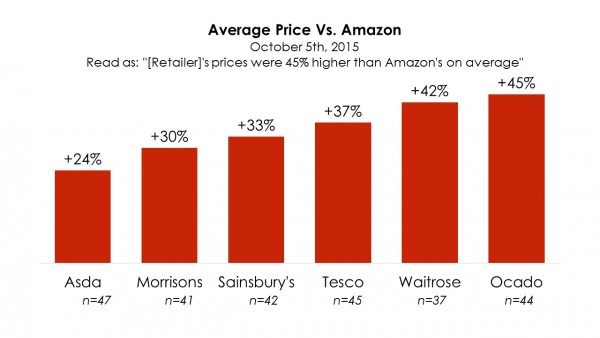
Anderston found that Amazon Prime Now was the clear price leader on these 49 products: all six supermarkets were shown to be priced higher than Amazon. However, while all supermarkets’ prices on these items were higher than Amazon Prime Now, we found that there were varying degrees of price competitiveness between them.

For example, the average product was found to be 45% more expensive on Ocado than on Amazon, while Asda and Morrisons prices were 24% and 30% higher respectively.


Figure 1: Average UK supermarket price vs Amazon Prime Now, October 5 2015 (Source: Profitero)

 And when Anderson did a deeper dive into the price distribution of UK supermarkets versus Amazon Prime Now, we found that 75% of Ocado’s products were priced higher than the same products sold on Amazon (just 20% of products were priced the same).

By contrast, Asda priced the same as Amazon across 49% of its products.


Figure 2: Price distribution vs Amazon Prime Now, October 5 2015 (Source: Profitero)

Is your business model evolving? Are you exceeding your customer expectations? I hope you have said yes to both, because if you are not others will. 

www.FoodserviceSolutions.us  specializes in outsourced business development. We can help you identify, quantify and qualify additional food retail segment opportunities or a brand leveraging integration strategy.  Foodservice Solutions® of Tacoma WA is the global leader in the Grocerant niche visit, Linkedin.com/in/grocerant or twitter.com/grocerant Contact Steve@FoodserviceSolutions.us