Showing posts with label Yum! Brands. Show all posts

Wednesday, September 24, 2025

Should KFC be Spun out from Yum! Brands


From a highway lunch counter to a global icon — a quick historical run

Harland “Colonel” Sanders began frying chicken at a service station in Corbin, Kentucky, during the Great Depression; his franchising idea grew into the first KFC franchise (Salt Lake County, Utah) in 1952, and Sanders sold the company to investors in 1964 while his image remained integral to the brand. KFC was among the first U.S. fast-food chains to aggressively expand overseas in the 1960s, helping make fried chicken a global fast-food category.

KFC later became part of PepsiCo’s restaurant portfolio and — along with Pizza Hut and Taco Bell — was spun out as an independent public restaurant company in 1997 (initially Tricon; renamed Yum! Brands in 2002). Yum! itself completed a further geographic carve-out when it spun off Yum China in 2016. Today Yum! operates tens of thousands of restaurants worldwide, with KFC remaining one of its largest and most internationally expansive brands.

In recent years KFC has shown strong digital momentum in parts of the world (notably China and other international markets), with Yum! reporting double-digit digital sales growth for KFC and — in some periods — digital mix exceeding 50% of KFC system sales. At the same time, KFC has faced headwinds in the U.S. market where competitive chicken chains and changing consumer habits have pressured same-store sales according to Steven Johnson Grocerant Guru® at Tacoma, WA based Foodservice Solutions®.  


Why Yum! Brands should think twice before selling or spinning off KFC (the case for keeping it)

Below are strategic, fact-based reasons why KFC remains a strategic asset for Yum!, supported by the company’s recent disclosures and industry context.

1.       Global scale and diversification of revenue — KFC is one of Yum!’s most geographically diversified chains, performing especially well in high-growth international markets (China, Middle East, Africa). That international footprint helps balance volatility across brands and regions.

2.       Digital & operations synergies across brand portfolio — Yum! has centralized programs (digital platforms, supply-chain scale, franchise systems) that drive down unit costs and enable rapid tech rollouts (kiosks, apps, loyalty). KFC benefits from shared capability investments Yum! makes across Pizza Hut and Taco Bell.

3.       Franchise network scale and capital-light growth model — Yum!’s largely franchised model lets it expand quickly with lower capital intensity. A standalone KFC would still need to duplicate corporate functions or pay for services previously provided centrally, reducing free cash flow.

4.       Brand economics in international markets — In many countries KFC is the top chicken brand and a substantial driver of system sales growth. Spinning off KFC could reduce the parent’s access to high-return, international growth.

5.       Risk-management: portfolio balance during U.S. softness — U.S. same-store soft patches (noted in recent quarters) hit KFC domestically — but Yum! can offset those troughs with stronger Taco Bell or international performance. Selling KFC would expose Yum! to concentration risks in its remaining brands.

Bottom line: KFC is not merely a fast-food brand — it’s a global growth engine, digital testbed, and franchise platform that currently amplifies Yum!’s scale benefits. Selling now would forfeit those integrated advantages and the shared economies of a multi-brand restaurant platform.


Yet — five proactive reasons Yum! might consider spinning KFC out (user requested a positive spin-off case)

(If Yum! were to consider a spin-off, these are the constructive reasons a management team could cite.)

1.       Unlock hidden value for shareholders — Public markets sometimes value focused, single-brand companies higher than multi-brand conglomerates. An independent KFC could attract investors specifically targeting international chicken growth and emerging-market exposure.

2.       Strategic focus and faster innovation for KFC — Free from multi-brand corporate priorities, a standalone KFC could prioritize chicken innovation, menu R&D, and brand marketing tailored only to its customer base.

3.       Tailored capital allocation — As an independent company, KFC could raise capital, set capex, and execute buybacks or M&A focused purely on chicken and hospitality adjacent opportunities (e.g., quick-service chicken chains, grocery retail partnerships).

4.       Clearer performance accountability — Investors and management would get single-P&L clarity: KFC’s operational metrics, margins, and ROI would be unbundled from Pizza Hut and Taco Bell, making performance management and incentives more direct.

5.       Ability to attract specialized leadership and partnerships — A stand-alone KFC could recruit executives with deep poultry/restaurant retail experience and pursue partnerships (supply chain, cold-chain tech, grocery “grocerant” tie-ins) that a multi-brand parent might deprioritize.


Five ways KFC could thrive away from Yum! — operational and strategic playbook

If KFC were spun out, here are five realistic paths to accelerate its growth as an independent company.

1.       Double down on international market-by-market playbooks — Give regional leadership autonomy and resources to localize menus, pricing, and formats (street-side kiosks in APAC, value buckets in LATAM, family-style offerings in MENA). Local focus drove KFC’s historical successes overseas and can be amplified.

2.       Aggressive omnichannel & retail partnerships (the “grocerant” lift) — Expand grocery-ready product lines (seasoned wings, meal kits), retailer shop-in-shops, and co-branded frozen lines to capture more at-home consumption occasions beyond restaurants.

3.       Franchise economics & small-format expansion — Accelerate nontraditional formats (delivery kitchens, mall kiosks, convenience partnerships) that lower rent and build density in urban and delivery-first markets.

4.       Supply-chain and protein innovation — Invest in vertically integrated sourcing, higher-welfare poultry commitments, and new product development (plant-forward chicken analogs, premium chicken sandwiches) to capture health and sustainability-minded customers.

5.       Brand refresh and premiumization where it fits — Reintroduce quality cues (heritage recipes, chef collaborations, limited-time premium offerings) to stop share erosion to newer premium chicken chains while maintaining value offerings in price-sensitive segments.

Each of the above requires capital and focused management; as a standalone firm, KFC could more directly allocate investment to these priorities — but it would also forgo shared services and scale benefits Yum! currently provides.


Four insights from the Grocerant Guru on how KFC can rekindle brand relevance

(Practical, execution-focused counsel from a grocerant / retail-restaurant strategist persona.)

1.       Treat KFC as both a restaurant brand and a consumer packaged goods (CPG) platform.
The Guru: “Consumers who love KFC in restaurants will buy your product in stores if it tastes right and is emblazoned with authentic heritage cues.” Action: launch premium refrigerated/frozen SKUs and grocery meal solutions that echo restaurant favorites and are optimized for shelf and home reheating.

2.       Use menu platforms to build ritualized occasions — not only value promotions.
The Guru: “Don’t default to buckets and price cuts. Make signature occasions: weekday family nights, limited-edition sandwich drops, and regional spice festivals.” Action: calendarize launches, tie them to loyalty rewards, and make them social-media friendly.

3.       Make the supply promise part of the brand story.
The Guru: “Modern consumers scrutinize where protein comes from. Transparent sourcing, welfare steps, and a visible cold-chain story make KFC feel modern without losing its indulgent heritage.” Action: publish sourcing milestones and product lifecycle stories that are short, visual, and localizable.

4.       Leverage microformats for experimentation and speed.
The Guru: “Test new menu items and partnerships in 500 micro-stores before a national roll-out. Learn fast and fail cheaply.” Action: deploy small urban delivery kitchens and grocery pop-ups as R&D labs feeding the national pipeline.


Tradeoffs: reality checks to balance the rhetoric

·       If kept inside Yum!, KFC benefits from shared digital platforms, cross-brand loyalty scale, and franchisee network effects — but it may not get single-brand priority for all capex or CEO attention.

·       If spun out, KFC gains strategic clarity and the freedom to pursue grocery, retail, and vertical integration aggressively — but it loses instant scale economics, centralized tech investments, and some franchise scale that reduced per-unit costs.


Final perspective

KFC is simultaneously a heritage brand, an international growth engine, and a lab for chicken innovation. The right decision — keep, sell, or spin off — depends on what Yum! and KFC’s leaders value most: consolidated scale and shared efficiencies, or laser focus and independence to pursue grocery/retail and faster product pivots.

If Yum! wants the safety, shared investments, and global-leverage that come with a multi-brand parent, it should think twice about a divestiture now. If, however, leadership wants to unlock brand-specific capital, innovation, and retail partnerships that require single-brand focus, a carefully-managed spin-out (with retained strategic alliances) could be structured to deliver value — but only with a disciplined transition plan to replace the lost corporate services and preserve international momentum.

Outsourced Business Development—Tailored for You

At Foodservice Solutions®, we identify, quantify, and qualify new retail food segment opportunities—from menu innovation to brand integration strategies.

We help you stay ahead of industry shifts with fresh insights and consumer-driven solutions.

🔗 Connect with us on social media: Facebook, LinkedIn, Twitter

Ready to Find Your Next Success Clue?

We specialize in outsourced food marketing and business development ideations—helping brands seize opportunities in food retail, technology, and menu innovation.

📩 Reach out today: Steve@FoodserviceSolutions.us
🔗 Follow us: Facebook, LinkedIn, Twitter


Thursday, May 18, 2023

Taco Bell Wants to Profit off Bulling PR and Marketing is Bull Shit


One global restaurant chain Taco Bell apparently thinks that it can profit off bulling-marketing/PR.  According to Steven Johnson Grocerant Guru® at Tacoma, WA based Foodservice Solutions® that is Bull Shit! Johnson stated, “with school yard bulling at near all-time highs, Taco Bells attempt to garner new customers is a professional miss-step, completely unprofessional, and an insult to their customers.”  Bulling is looking back Taco Bell needs to stop bulling PR and Marketing and start looking a customer ahead.

First let’s define bullying, as the use of force, coercion, hurtful teasing or threat, to abuse, aggressively dominate or intimidate. The behavior is often repeated and habitual. One essential prerequisite is the perception of an imbalance of physical or social power. This imbalance distinguishes bullying from conflict. Bullying is a subcategory of aggressive behavior characterized by hostile intent, imbalance of power and repetition over a period of time. Bullying is the activity of repeated, aggressive behavior intended to hurt another individual, physically, mentally or emotionally. Given Taco Bell’s marketing budget and global reach there can be no doubt that there is an imbalance of power and social clout that is once again at work.

So, currently Taco John’s owns the Taco Tuesday registration in 49 states, while “a small business” called Gregory’s owns the registration in New Jersey. Taco Bell is seeking to cancel those registrations. Now Taco John’s is a much smaller growing company and Gregory’s is even smaller.  Let’s give credit to Taco John’s for doing all of the right things, applying for registration in 49 states while respecting Gregory’s registration. 


Then there is the global Taco Bell with higher unit volumes and thousands more stores that when Taco John’s applied for registration was given plenty of time to challenge and did not. Even more disappointing is the fact that Taco Bell is owned by the behemoth Yum! Brands.  Clearly Yum! Brand’s oversite must have been missed-sight according to Johnson.

When many of your primairy and sedonalry targeted customers are still in school it counter intuitive that you would use bulling marketing to will over your customers especially when schools, school districts, states and the National Education Association are working so hard to stop bulling. So, Taco Bell here are some facts bulling you might want to review:


1. One out of every five (20.2%) students report being bullied. (National Center for Educational Statistics, 2019 

2.  A higher percentage of male than of female student’s report being physically bullied (6% vs. 4%), whereas a higher percentage of female than of male students reported being the subjects of rumors (18% vs. 9%) and being excluded from activities on purpose (7% vs. 4%). (National Center for Educational Statistics, 2019

3.  41% of students who reported being bullied at school indicated that they think the bullying would happen again. (National Center for Educational Statistics, 2019 ) 

4.  Of those students who reported being bullied, 13% were made fun of, called names, or insulted; 13% were the subject of rumors; 5% were pushed, shoved, tripped, or spit on; and 5% were excluded from activities on purpose. (National Center for Educational Statistics, 2019

5.  A slightly higher portion of female than of male students report being bullied at school (24% vs. 17%). (National Center for Educational Statistics, 2019

6.  Bullied students reported that bullying occurred in the following places: the hallway or stairwell at school (43%), inside the classroom (42%), in the cafeteria (27%), outside on school grounds (22%), online or by text (15%), in the bathroom or locker room (12%), and on the school bus (8%). (National Center for Educational Statistics, 2019

7.  46% of bullied students report notifying an adult at school about the incident. (National Center for Educational Statistics, 2019

8.  School-based bullying prevention programs decrease bullying by up to 25%. (McCallion & Feder, 2013

9.  The reasons for being bullied reported most often by students include physical appearance, race/ethnicity, gender, disability, religion, sexual orientation. (National Center for Educational Statistics, 2019

10.  The federal government began collecting data on school bullying in 2005, when the prevalence of bullying was around 28 percent. (U.S. Department of Education, 2015 )

11.  Rates of bullying vary across studies (from 9% to 98%). A meta-analysis of 80 studies analyzing bullying involvement rates (for both bullying others and being bullied) for 12-18 year old students reported a mean prevalence rate of 35% for traditional bullying involvement and 15% for cyberbullying involvement. (Modecki, Minchin, Harbaugh, Guerra, & Runions, 2014 )

12.  One in five (20.9%) tweens (9 to 12 years old) has been cyberbullied, cyberbullied others, or seen cyberbullying. (Patchin & Hinduja, 2020

13.  49.8% of tweens (9 to 12 years old) said they experienced bullying at school and 14.5% of tweens shared they experienced bullying online. (Patchin & Hinduja, 2020

14.  13% of tweens (9 to 12 years old) reported experiencing bullying at school and online, while only 1% reported being bullied solely online. (Patchin & Hinduja, 2020)

In case you have not read about it; Taco Bell's petition to cancel Taco Tuesday trademarks in the minds-eye of our Grocerant Guru® are inappropriate and unprofessional at best.


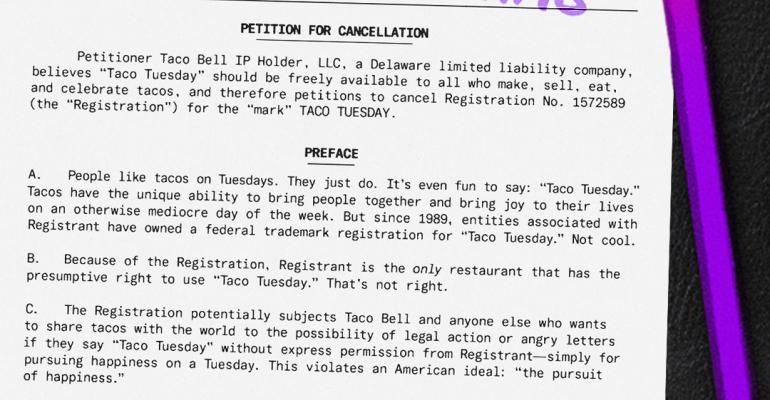
Yes, Taco Bell is fighting to “liberate” Taco Tuesday. The company announced this week that it has filed legal petitions to cancel the federal trademark registrations for “Taco Tuesday” via the USPTO Trademark Trial and Appeal Board. The company says it believes “Taco Tuesday” should belong to “all who make, sell, eat and celebrate tacos.”

“In fact, the very essence of ‘Taco Tuesday’ is to celebrate the commonality amongst people of all walks of life who come together every week to celebrate something as simple, yet culturally phenomenal, as the taco. How can anyone Live Más if they’re not allowed to freely say ‘Taco Tuesday?’ It’s pure chaos,” the company wrote in a statement.

Here is just one example that Taco Bell is using bulling PR to capitalize on others pain steaking hard work.  Taco Bell is not seeking damages or trademark rights, but rather the ability for usage of a common term via the cancelation of trademark registrations; meaning no one restaurant will be able to claim exclusive rights to Taco Tuesday. Taco Bell said it wants “Taco Tuesday” to be free for all restaurants and vendors to use the term without fear of a cease-and-desist letter or lawsuit. In our minds-eye that is bulling PR to demish the value of the trademark of Taco John’s and Gregory’s.

Once again, the fact is, Taco John’s owns the Taco Tuesday registration in 49 states, while “a small business” called Gregory’s owns the Taco Tuesday registration in New Jersey. Taco Bell is seeking to cancel Taco John’s registration and has also filed a petition to cancel Gregory’s registration covering New Jersey.


“This is the only way to achieve liberation in all 50 states, which is Taco Bell’s sole objective behind this effort,” the company said. Marketing and PR stunts that are simple bulling are unprofessional and Yum! Brands know better.  

Once processed, Taco Bell’s petitions will be available on the USPTO Trademark Trial and Appeal Board’s website. An excerpt from the company’s legal petitions can also be found online.

Bulling is not Looking a Customer Ahead!

Foodservice Solutions® team is here to help you drive top line sales and bottom-line profits. Are you looking a customer ahead? Visit GrocerantGuru.com for more information or contact: Steve@FoodserviceSolutions.us Remember success does leave clues and we just may the clue you need to propel your continued success.

Do you Want to Build a Larger

Share of Stomach

Respect Others 


Saturday, February 6, 2021

Taco Bell's $5 Homerun


I get asked all the time ‘how do we keep our brand relevant”? The answer is simple.  Your brand should be an invitation, use your brand to invite new customers and edify existing customers. Steven Johnson, Grocerant Guru® at Tacoma, WA based Foodservice Solutions® stated Taco Bells new ‘Build Your Own Craving’ is an example of leveraging a brands value while edifying the customer relationship.  

So, the Build Your Own Cravings allows customer to create their meal exactly as they please, whether they’re craving vegetarian options, swapping out a protein for beans, or just sticking with the classics.

Consider this, if you were to take a boring burger bundle, add a celebrity in the mix, put it online, then you’ve got the perfect recipe for, well, eating someone else’s favorites. So, Taco Bell wondered, why not empower each customer? That’s right you can just Eat Like You? Your favorites. All together. For just $5.

It’s a way to edify their most passionate frequent customers first, the new Build Your Own Cravings Box will be available exclusively to Taco Bell Rewards Beta members on the Taco Bell app now and to other Taco Bell digital customers members on February 11, 2021.

We agree that the Build Your Own Cravings Box is the ultimate Taco Bell eating experience. Packaged in a convenient, recyclable paperboard box, fans can create their meal exactly as they please from a selection of well-loved favorites. With the click of a button, 18 different variations come to life on Taco Bell’s mobile and website, showcased in the following categories:

Specialties—a signature item like the Chalupa Supreme, Cheesy Gordita Crunch or Crunchwrap

Starters—a Crunchy Taco, Soft Taco, Beefy 5-Layer Burrito or Bean and Cheese Burrito

Sides—Of course, the meal wouldn’t be complete without either Chips & Nacho Cheese Sauce or Cinnamon Twists

Drinks—A choice of Medium fountain drink rounds out the exclusive offer

The Build Your Own Cravings allows customers to create their meal exactly as they please, whether they’re craving vegetarian options, swapping out a protein for beans, or just sticking with the classics. How you build your box is up to you, no matter your protein preference.


Nikki Lawson, Taco Bell’s Chief Global Brand Officer stated, “As we see it, there aren’t a lot of choices out there when it comes to value, forcing customers to play by others’ rules. But when your customers have different favorites on the menu, why not celebrate that?” ... “The Taco Bell I’m proud to lead does it differently—we put fans in the driver's seat and allow them to eat how they want to eat, not how someone, irrespective of how famous they may be, tells them to.”

Empowering an interactive participatory customer relationship Taco Bell is going all in on the launch with marketing that empowers fans to take pride in their unique crunchy, cheesy or spicy taste. The digital and social campaign includes some of Taco Bell’s most influential fans including actor Noah Centineo, TikTok influencer Nava Rose, K-Pop star CL, iconic Drag Queen Onyx Black, and BMXer Brad Simms, among others.

Note, the celebrities won’t be sharing their own orders, but rather reminding consumers to never settle for someone else’s taste buds. With no predetermined celebrity meal in sight, fans will be encouraged to share their own unique Cravings Box orders on social platforms, such as TikTok, with a never-before-seen filter and hashtag challenge, and will even be able to take on the role of a lifetime as they act alongside Noah Centineo in a passionate TikTok duet. Customers should keep their eye on Taco Bell’s social channels and even their own for your page for information and even more surprises.

Are you ready for a marketing homerun?  Are you ready for some fresh ideations? Do your food marketing ideations look more like yesterday than tomorrow? Interested in learning how Foodservice Solutions® can edify your retail food brand while creating a platform for consumer convenient meal participationdifferentiation and individualization?  Email us at: Steve@FoodserviceSolutions.us or visit us on our social media sites by clicking the following links: Facebook,  LinkedIn, or Twitter