Showing posts with label ToGo Food. Show all posts

Tuesday, September 1, 2026

The Frozen Food Court Meets the Fresh Food Revolution: PDQ Shows How Restaurants Can Own the Game-Day Meal


The football season has always been about more than football. It is about gathering, grazing, sharing, snacking and—perhaps most importantly—feeding a crowd without spending the entire game day in the kitchen according to Steven Johnson, The Grocerant Guru® at Tacoma, WA based Foodservice Solutions®

That is why PDQ’s latest promotion caught my attention.

PDQ, known for its crispy, hand-breaded chicken tenders and sandwiches, is launching a football-season offer that is a textbook example of how restaurants can extend their brands beyond the traditional restaurant occasion.

From September 9 through September 13, customers can buy a platter of 25 Reheat Tenders and get another 25 tenders free. Pre-orders begin August 27, with pickup available September 9–13. Customers order in-store or online using the code BIGGAME, with a limit of two redemptions per check.

In other words, PDQ is not simply selling chicken.

PDQ is selling a solution to a meal occasion.

And that distinction matters.


Consumers Don't Want to Cook—They Want to Assemble

The food industry has been talking about convenience for decades. But today's consumer is redefining what convenience actually means.

Convenience increasingly means getting a high-quality meal on the table with almost no preparation.

Circana's 2026 research makes the point dramatically: about half of all meals now take less than five minutes to prepare. That includes 65% of breakfasts, 56% of lunches and 35% of dinners. Circana also reports that frozen dinners and entrées now account for nearly 5% of in-home eating occasions, compared with less than 1% in the 1980s.

That is not merely a frozen-food story.

It is a foodservice opportunity.

PDQ understands something many restaurant marketers still miss: the restaurant does not have to own the entire eating occasion to own a meaningful piece of it.

A consumer can buy restaurant-quality food, take it home, reheat it and create a social occasion around it.

That's grocerant thinking.

Fresh Food Has Become a Foodservice Destination

The grocery industry is discovering the same opportunity from the opposite direction.


FMI's Power of Foodservice at Retail 2025 found that the share of consumers choosing deli-prepared foods instead of restaurant meals more than doubled—from 12% in 2017 to 28% in 2025.

Even more revealing, 53% of Americans are taking a hybrid approach, combining deli-prepared foods with food they prepare themselves. Retail foodservice dollar sales reached $52.1 billion, up 1.6% over the preceding 12 months.

Read that again.

Consumers aren't necessarily choosing between restaurants and grocery stores.

They are using both.

That is the foundation of the modern grocerant economy.

Costco's Rotisserie Chicken Is the Poster Child

Look no further than Costco.

Costco sold approximately 157.4 million rotisserie chickens globally in fiscal 2025—more than 431,000 per day.

That isn't simply a successful grocery product.

It is a foodservice phenomenon operating inside a retail environment.

The Costco rotisserie chicken became an iconic value proposition because it delivers something consumers understand immediately:


Dinner is ready.

And the product doesn't necessarily end with the chicken itself. Prepared chicken can become sandwiches, salads, soups and other meal components.

That is precisely how the foodservice-at-retail model creates additional occasions.

Fresh Isn't the Only Winner

For years, food marketers treated frozen as the lesser cousin of fresh.

That thinking is outdated.

The Frozen Food Court—my term for the increasingly important space where restaurant brands, foodservice concepts and recognizable food brands compete for attention in the grocery freezer—continues to evolve.

Frozen provides something fresh cannot always match:

inventory flexibility.

It gives consumers the ability to purchase a meal today and eat it days or weeks later.

That matters when consumers are managing busy schedules, food budgets and unpredictable meal occasions.

Circana continues to track frozen food as a major component of the center-store opportunity, with frozen-food sales and category shifts being closely monitored as consumer behavior evolves.

And the restaurant industry should be paying attention.

The Frozen Food Court gives restaurant brands an opportunity to put their name, flavor profile and food proposition into the home without requiring the consumer to visit the restaurant.

That is an enormous expansion of the brand's addressable eating occasion.

Restaurant Brands Are Learning to Travel

The winners in foodservice increasingly understand that their brands need to travel.

A restaurant's relationship with a consumer shouldn't necessarily end when the customer leaves the parking lot.


The brand can travel home through:

·       Reheat meals

·       Family meals

·       Catering

·       Party platters

·       Frozen products

·       Grocery partnerships

·       Take-home sauces

·       Meal kits

·       Prepared foods

·       Delivery

·       Digital ordering

PDQ's Reheat Tender Platter is particularly interesting because it bridges two worlds.

It is fresh restaurant food designed for a future consumption occasion.

That is different from simply selling a hot meal.

The consumer doesn't have to eat it immediately.

That creates a new dimension of convenience.

The Fresh-Frozen Divide Is Disappearing

Here is where I believe food marketers need to rethink the conversation.

The future isn't necessarily fresh versus frozen.

It is fresh plus frozen plus ready-to-eat plus heat-and-eat plus restaurant foodservice.


Consumers are becoming channel agnostic.

They care about the food, the price, the quality, the convenience and whether it solves today's meal problem.

FMI's 2026 research continues to position fresh food as central to food retail's ability to attract shoppers and create competitive advantage.

Meanwhile, frozen provides affordability, availability, convenience and longer shelf life.

Restaurants provide craveability, culinary credibility and brand recognition.

The smartest companies are finding ways to combine these advantages rather than forcing consumers to choose one.

Football Is the Perfect Test Case

PDQ's promotion works because it starts with the occasion, not the menu.

Football creates a predictable need:

"I have a bunch of people coming over. What am I going to feed them?"

Twenty-five tenders isn't necessarily a restaurant meal.

Fifty tenders certainly isn't.

It is a social food solution.

And that is the difference between menu marketing and occasion marketing.

PDQ isn't telling consumers:

"Come to our restaurant and buy chicken."

It is effectively telling them:

"We'll help you feed the crowd."

That is a much bigger proposition.

And football is just one occasion.

Think about birthdays, children's sports, office meetings, graduation parties, movie nights, family gatherings, holidays, tailgating, neighborhood parties and last-minute entertaining.

Every one represents a potential foodservice occasion.


The Real Opportunity: Own the Meal, Not Just the Restaurant Visit

The restaurant industry has historically measured success by transactions, traffic, check averages and frequency.

Those metrics still matter.

But the bigger question is:

How many meal occasions does your brand participate in?

That is the metric I would want food marketers thinking about.

A restaurant that sells one dinner to a customer owns one meal occasion.

A restaurant that sells a 50-piece platter for a football party may participate in an occasion involving 10, 15 or 20 consumers.

A restaurant that also sells frozen products or take-home meals can potentially participate in dozens of additional occasions without adding another dining-room seat.

That's leverage.


Three Insights From the Grocerant Guru®

1. Stop marketing food products and start marketing meal solutions.

Consumers don't wake up thinking about your SKU, menu architecture or merchandising strategy. They wake up wondering what they are going to eat—and how much work it will take to get it. The brand that solves that problem wins.

2. The Frozen Food Court is not competition for restaurants—it can be an extension of the restaurant brand.

Restaurant marketers should stop looking at grocery freezers solely as a competitor. The freezer can become another distribution channel, another billboard and another way to create brand trial and household penetration.

3. The next battleground isn't restaurants versus grocery—it is whoever owns the consumer's next meal occasion.

Fresh, fresh frozen, restaurant takeout, grocery deli, convenience stores and delivery are increasingly colliding around the same consumer. The winners won't be the companies defending yesterday's channel boundaries. They will be the companies willing to follow the consumer wherever the next meal happens.

Something to think about:

If your brand only knows how to sell a meal when the consumer walks through your front door, you don't own the meal occasion—you only own the dining room.

Success Leaves Clues—Are You Ready to Find Yours?

One key insight that continues to drive success is this: "The consumer is dynamic, not static." This principle is the foundation of our work at Foodservice Solutions®, where Steven Johnson, the Grocerant Guru®, has been helping brands stay relevant in an ever-evolving market.

Want to strengthen your brand’s connection with today’s consumers? Let’s talk. Call 253-759-7869 for more information.

Stay Ahead of the Competition with Fresh Ideas

Is your food marketing keeping up with tomorrow’s trends—or stuck in yesterday’s playbook? If you're ready for fresh ideations that set your brand apart, we’re here to help.

At Foodservice Solutions®, we specialize in consumer-driven retail food strategies that enhance convenience, differentiation, and individualization—key factors in driving growth.

Email us at Steve@FoodserviceSolutions.us Connect with us on social media: Facebook, LinkedIn, Twitter


Tuesday, January 2, 2024

Eating-Out While Eating-In Continues to Delight Consumers


We have been told that as a result of the tax cuts to expect higher wages, a booming economy, and growth which means time starved consumers will see an increase demand on their time according to Steven Johnson, Grocerant Guru® at Tacoma, WA based Foodservice Solutions® So in 2018 expect to see an increase in consumers desire for Grocerant niche Ready-2-Eat and Heat-N-Eat fresh prepared food.

Sometimes looking back at some facts adds relevance to today’s numbers. According to foodservice industry icon back in the day Bonnie Riggs of The NPD Group found that, “50 percent of dinners purchased from restaurants are consumed at home, and Riggs expects that to grow in 2018.”  Now consider that was then.  Once again,  our own Grocerant Guru® was the first identify, quantify, and qualify Eating-Out while Eating-In. Is your food portable?  Are you selling meals for both inside and outside your four walls? 


Price just might trump portability in 2024 as McDonalds value promotion are all but gone beginning in January keep a close eye on all of the fresh food and fast food companies discounts incentives to drive traffic. 

The retail foodservice Price + Value +Service = Equilibrium will be reset in early 2024 as consumers value price over most loyalty programs.  Do you have menu items designed, positioned, and priced to garner a larger share of stomach in 2024? 

Foodservice Solutions® team believes that mobile marketing drives delivery creating a new platform of fresh food distribution.  Foodservice branded mobile App’s that extend a branded messaging, offered as a trial invitation will become more relevant as a marketing tool than most legacy loyalty programs.

Interested in learning how Foodservice Solutions 5P’s of Food Marketing can edify your retail food brand while creating a platform for consumer convenient meal participation, differentiation and individualization? Email us at: Steve@FoodserviceSolutions.us or visit:  www.FoodserviceSolutions.us for more information.


Wednesday, July 14, 2021

Are Roller Grill’s Still Necessary


The number one article read on the Foodservice Solutions® blog since 2009 continues to be Roll, Roll, Roll, Away Roller Grill, according to Steven Johnson, Grocerant Guru® at Tacoma, WA based Foodservice Solutions®.

Johnson, and the team at Foodservice Solutions® admits that they downplayed, the intersection of food preparation simplicity and profitability, and looked more at consumers trends and the growing demand under the ‘halo’ of better for you, food options.

That said, there is no doubt that customer trends continue to favor fresh food, fast and the appetite for a simple heated roller grill meal substitute is waning.  Yet, the team at Foodservice Solutions® thinks it important to share the insight from Isabelle Gustafson has to say about roller gills in C-stores today.

Here is what Gustafson had to say about roller grills today: “As the line between c-stores and quick-serve restaurants (QSRs) becomes increasingly blurred, and consumers become more accustomed to made-to-order foodservice, the roller grill is no longer a given.

As with all c-store segments, operators must ask themselves whether the roller grill is the best fit at their locations. So, what sets the roller grill apart from other foodservice offers, and how do you know if a roller grill is right for your c-store?


Space-Saver

The roller grill can be a great option for any c-store, but it’s especially helpful for c-stores with very limited space. A super-small store may not have room for the type of kitchen necessary for made-to-order foodservice. The roller grill provides these types of stores with a solid foodservice option that takes up minimal space.

We know that today’s consumers love customization, and this is where made-to-order foodservice options really shine. But customization can be challenging for operators, especially for c-stores, given their space constraints.

Self-Serve

The roller grill is especially beneficial for stores with not only limited space, but also limited employees.

Because the roller grill is self-serve, it’s a great way to keep labor costs low while still providing customers with a great grab-and-go foodservice option. While, of course, the roller grill must be properly and frequently cleaned and restocked, it’s relatively low-maintenance compared with other offers.

Granted, the pandemic did pose some unique challenge for the roller grill in particular: Amid shutdowns and heightened concerns over food safety, along with regional regulations, some retailers paused roller grill sales altogether. Meanwhile, others were able to bring the segment behind the counter as a way to meet COVID-19 safety requirements while continuing to serve customers.


Grab-and-Go

While made-to-order foodservice is increasingly popular, there’s a reason the roller grill is a tried and true favorite for c-stores: The roller grill is the ultimate convenience — a quick and easy lunch or snack for customers in a hurry.

Roller grill offers also tend to be less expensive than made-to-order foods while still being some of Americans’ favorites.

In fact, overall sales of hot dogs actually rose about 20% in 2020, and total pounds 7% over 2019, according to the National Hot Dog & Sausage Council. In March, at the start of the pandemic’s spread in the. U.S., sales soared 127% in grocery stores specifically before they began to even out.

Dinner sausage sales experienced a similar increase. Overall in 2020, they were up 24% in sales and 15% in total pounds.

Ultimately, while the roller grill can be a great option for any store, big or small, no matter the location, there are a few key indicators to determine whether or not a roller grill is the right fit. As with most things, the answer will likely depend on your particular store’s needs and constraints as well as your specific clientele.

So, that was what Isabelle Gustafson had to say.  Do you know what we are saying today?  Once again, the trend is your friend. Let it go, the halo of better for you will drive more customer adoption than any thing else.

Do your food marketing ideations look more like yesterday than tomorrow? Interested in learning how Foodservice Solutions® can edify your retail food brand while creating a platform for consumer convenient meal participation, differentiation and individualization?  Email us at: Steve@FoodserviceSolutions.us or visit us on our social media sites by clicking the following links: Facebook,  LinkedIn, or Twitter


Sunday, March 21, 2021

Italian Fresh Food Manufacturing DalMoros is Grocerant Great


If success leaves clues and it does; DalMoros Fresh Pasta To Go, has found its place in the center of the grocerant niche with Ready-2-Eat and Heat-N-Eat fresh food that will find consumers dinner tables from coast to coast according to Steven Johnson, Grocerant Guru® at Tacoma, WA based Foodservice Solutions®.

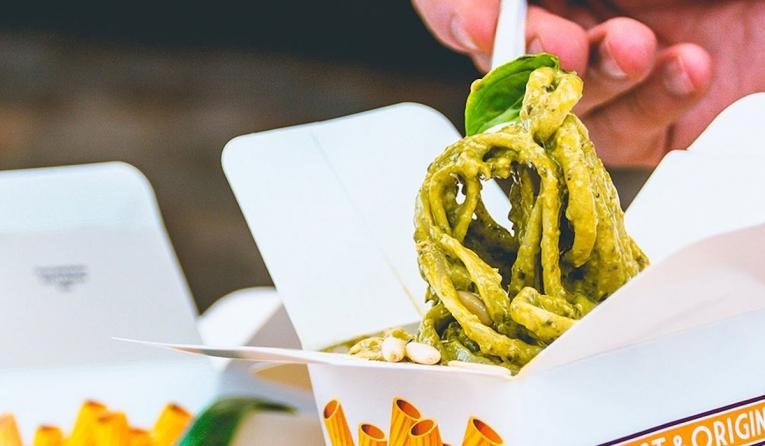
Italian food lovers and US customers the ilk of our Grocerant Guru® were glad to hear that DalMoros will open its first US outlet in St. Peterburg, Florida soon. Grocerant niche focused DalMoros Fresh Pasta To Go has a wide variety of fresh pastas and homemade sauces made from scratch right in front of the customers with each meal served in to go boxes and ready within minutes.

The St. Petersburg, Florida outlet is the first franchise in the United States for the popular, fast-casual, fresh pasta concept originating in Venice, Italy in 2012. Italian food lovers will delight in DalMoros St. Pete’s wide variety of fresh pastas and homemade sauces made from scratch right in front of the customers with each meal served in to go boxes and ready within minutes. Delicious toppings, tiramisu, fountain drinks, beer and wine will also be served.


DalMoros St. Pete franchisee David Caruso, stated, “Coming from an Italian heritage, we’ve always had a love for Italian cuisine, especially fresh pasta,” … “Luckily, we were connected with Gabriele Dal Moro, whose fresh pasta to go concept has attracted thousands of people to his pasta shop in Venice, Italy.  It is the first of its kind and truly a revolutionary way to enjoy fresh pasta without the need to sit down at a formal restaurant.  We are very proud to be able to bring this fabulous idea to the United States and finally open.  Everyone loves fresh pasta, but typically it is hard to find outside of the kitchen or a gourmet restaurant – this changes that.”

Fresh food manufacturing companies based here in the US have been slow to adopt too a franchise model. However our Grocerant Guru® believes that the global success of DalMoros St. Pete franchisee David Caruso will hep speed things up here. Are you ready to grow? Great Grocerant Growth Awaits.

Along with Caruso, DalMoros St. Pete’s team includes General Manager and Head Chef Alberto Buniato who hails from Milan, Italy. Their team plans to open more DalMoros first throughout Southwest Florida and then eventually the rest of the United States.  Currently, DalMoros locations include Italy, Canada, Spain, and now St. Petersburg.  Future international openings are scheduled for Singapore, Barcelona and Mexico

Success does leave clues. One clue that time and time again continues to resurface is “the consumer is dynamic not static”.  Regular readers of this blog know that is the common refrain of Steven Johnson, Grocerant Guru® at Tacoma, WA based Foodservice Solutions®.  Our Grocerant Guru® can help your company edify your brand with relevance.  Call 253-759-7869 for more information.